
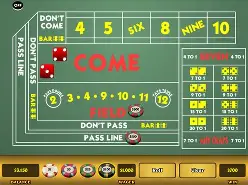
Most people walk up to a craps table completely overwhelmed, then walk away wondering where their bankroll went. Learning how to play craps and win more often is about structure, not luck tricks or “secret systems”. In this guide, you’ll get a clear, practical roadmap to play with confidence, cut out the sucker bets, and give yourself the best possible shot every session.
By the end, you’ll understand the core rules, the bets that actually make sense, how to manage your bankroll, and a simple, repeatable approach you can use both online and in a live casino.
How to play craps and win: start with the basics
If you want to know how to play craps and win more consistently, you must first understand the core flow of the game. Everything revolves around the come-out roll and then either establishing a point or resolving immediately.
Here’s the basic structure:
- The shooter (dice thrower) makes a come-out roll.
- If they roll 7 or 11, the Pass Line wins. If they roll 2, 3, or 12, the Pass Line loses (that’s called “craps”).
- Any other number (4, 5, 6, 8, 9, 10) becomes the point. The shooter keeps rolling until they either hit the point again (Pass Line wins) or roll a 7 (Pass Line loses).
Every fancy bet you see on a craps layout is built on top of that structure. When you focus on learning that core loop first, the table suddenly feels a lot less intimidating.
A personal tip: the first time playing live, ignore all the boxes in the middle and just watch a few shooters with no money down. Say the results under your breath: “come-out roll, that’s a 6, point is 6, rolled an 8, still rolling, rolled a 6, Pass wins.” Do that for 10 minutes and the flow clicks.
The only bets you really need (to keep the edge low)
The heart of learning how to play craps and win is understanding which bets give the house the smallest edge. Most of the layout is designed to tempt you into high-edge bets with exciting payouts. That’s how casinos keep the lights on.
If you stick mostly to these, you’re off to a strong start:
1. Pass Line
- You win on 7 or 11 on the come-out roll.
- You lose on 2, 3, or 12.
- Any other number becomes the point; you win if that number is rolled again before a 7.
House edge: around 1.41%. That’s already much better than most casino games.
2. Don’t Pass
This is essentially “betting against the shooter”:
- You lose on 7 or 11 on the come-out roll.
- You win on 2 or 3, and 12 usually pushes (varies by table).
- Any other number becomes the point; you win if a 7 rolls before the point.
House edge: slightly better than Pass Line (about 1.36%), but socially it can feel awkward at a lively table because you’re usually cheering against the crowd.
3. Odds Bets (the best bet on the table)
Once a point is established, you can place an Odds bet behind your Pass Line or Don’t Pass bet. This bet pays true odds (no house edge) and is one of the few bets in a casino that doesn’t favor the house directly.
Examples (for Pass Line odds):
- Point 4 or 10: pays 2 to 1.
- Point 5 or 9: pays 3 to 2.
- Point 6 or 8: pays 6 to 5.
The catch: you must already have a Pass (or Don’t Pass) bet to take odds, and the table will have a maximum multiple of your base bet allowed (e.g., 3x, 5x, 10x odds).
From a “how to play craps and win” perspective, the simple rule is: always take odds when you can afford it, before you go spraying chips on fancy bets.
Simple, effective strategies that actually help
You don’t need a complicated “system” to play smart; you just need a structured approach. Here are a couple of practical, real-world strategies that blend low house edge with sane risk.
Strategy 1: Low-stress Pass Line + Odds
This is perfect for beginners and casual players:
- Bet the table minimum on the Pass Line.
- Once the point is set, take single or double odds behind your bet.
- That’s it. No other bets until you’re comfortable.
Why it works:
- You’re always on a low-edge main bet.
- Odds bets don’t add extra house edge; they just increase your total wager at fair odds.
- The action is easy to track, which reduces emotional mistakes.
Example: On a $10 table with 3x odds, you bet $10 Pass Line, point becomes 6, and you put $30 behind in odds. If the shooter hits a 6 before 7, you win $10 on the line and $36 on the odds (6:5), a solid return for a single decision.
Strategy 2: Place 6 & 8 and grind
The numbers 6 and 8 show up often in craps, and placing them can be a solid part of a conservative plan.
How it works:
- Wait for a point to be set.
- Place bets on 6 and 8 (ideally in units that maximize payout, often in increments of 6).
- Collect hits and choose a “press” strategy (e.g., press after two wins, not after every win).
Why players like it:
- 6 and 8 win relatively often.
- House edge is reasonable (around 1.52%).
- It gives you frequent small wins that help you stay in the game longer.
One personal rule: don’t start pressing aggressively (increasing bet size with every win) after just one hit. Take at least one or two wins at the base level to secure some profit, then start pressing slowly.
Bets to avoid if you’re serious about winning
When people ask how to play craps and win, they often want a shortcut. The “shortcut” is actually not falling for the worst bets on the layout. These bets look fun, but they bleed your bankroll over time.
High-house-edge bets to be careful with:
- Hardways (e.g., hard 4, hard 6): you’re betting on doubles like 2-2, 3-3, etc., before an easy way or 7 shows. Very tempting, but the edge is high.
- Any 7, Any Craps, and other one-roll propositions: these feel exciting because of big, instant payouts, but they carry huge house edges—often 10%–15% or more.
- Field bets: they can be attractive because they win on many numbers, but they also lose on several common rolls and aren’t as favorable as they first appear.
Think of these like desserts: fine occasionally for fun, but if your goal is to stretch your bankroll and have a real chance to walk away ahead, they shouldn’t be your main diet.
A simple rule that has saved many players money: If the box in the middle looks flashy and the payout is 7:1, 9:1, 15:1 or similar, it’s probably not your friend.
Bankroll management: the part most players skip
Knowing how to play craps and win more often isn’t just about bets; it’s about how you handle your money. The same strategy can feel safe or suicidal depending on how you size your bets.
Here’s a simple, practical framework:
- Decide your total session bankroll before you leave home or log in (e.g., $200).
- Set a win goal and a loss limit. For example, you might aim to walk if you’re up 50% ($300) or accept a max loss of half your bankroll ($100).
- Bet low enough to survive swings. On a $200 bankroll, $10 base bets with odds are reasonable; $50 base bets are asking for trouble.
A key insight: craps is streaky. You can easily see 6–8 losing decisions in a row, even on “good” bets. Your bankroll has to be able to handle that without forcing you into panic mode.
A personal example: early on, a common mistake was jumping stakes too quickly after a good session. One weekend up $300 at $10 stakes led to trying $25 stakes the next night. Six quick losing decisions later, the entire original bankroll was gone. Same strategy, wrong bet size.
Table etiquette and live vs. online play
Craps is as much about the experience as the math. Knowing basic etiquette keeps the game enjoyable and prevents awkward moments.
Live table etiquette basics:
- Don’t throw chips onto the table while the dice are in the air. Place bets when the dealer calls “bets are off/closed” accordingly.
- Keep your hands out of the way of the dice path.
- When you throw the dice, try to hit the back wall and keep the toss controlled, not wild.
- Be respectful of other players’ bets – don’t lean over them or splash chips carelessly.
Live tables are great for energy and excitement, but they can be overwhelming. If you’re just learning how to play craps and win without pressure, online craps is ideal:
- You can take your time reading the layout.
- No one sees your mistakes.
- Minimum bets are often lower, which is great for learning.
A smart approach: practice online with a strict bankroll and basic strategy (Pass Line + odds, maybe Place 6 & 8). Once you’re confident, take that same structure to a low-minimum live table.
Putting it all together into a winning plan
Let’s pull this into a simple, repeatable approach you can use as your personal “how to play craps and win” roadmap:
- Choose your environment: start online or at a low-limit live table.
- Use a clear base strategy:
- Option A: Pass Line + odds only.
- Option B: Pass Line + odds + Place 6 and 8.
- Avoid the middle of the table (proposition bets) for at least your first 10–20 sessions.
- Stick to your bankroll rules: set session bankroll, win goal, and loss limit.
- Track results: even a simple note on your phone with “date / buy-in / cash-out / main bets used” will teach you a lot over time.
You will still have losing sessions—this is a negative-expectation game overall—but you’ll lose more slowly and give yourself more chances to leave ahead.
The real edge you have is discipline: betting smart, avoiding the worst options, and walking away when you’re supposed to.
Conclusion: Ready to roll the dice the smart way?
Learning how to play craps and win more often isn’t about magic systems; it’s about combining a few strong fundamentals: low-edge bets, smart odds usage, solid bankroll management, and a cool head. Once you strip out the noise and the sucker bets, craps becomes a fast, fun game where you actually understand what’s going on and why.
If you’re ready to take the next step, pick one of the simple strategies above, set a realistic bankroll, and try a short, structured session—either online or at a low-limit table. Treat it as a test run. Note what worked, what felt confusing, and refine your approach from there. The dice won’t always cooperate, but your decisions can improve every single session.
FAQs about how to play craps and win
1. Can you really beat craps in the long run?
In the strict mathematical sense, no—every bet has a house edge, so over a long enough timeline the casino wins. What you can do is slow that edge down by focusing on low-house-edge bets (Pass/Don’t Pass, Odds, Place 6 and 8) and managing your bankroll so you have more winning sessions and fewer big blowouts.
2. What is the best bet for beginners at craps?
For most beginners, the Pass Line bet with odds is the best starting point. It’s easy to understand, has a low house edge, and keeps you engaged in the core flow of the game without overwhelming you with side bets.
3. Is the Don’t Pass bet better than the Pass Line bet?
Mathematically, the Don’t Pass bet has a slightly lower house edge than the Pass Line bet. However, it often feels like you’re “betting against the table”, which some players don’t enjoy. If you don’t mind that, Don’t Pass + odds is a very strong option.
4. How big should my bankroll be for craps?
A good rule of thumb is to bring at least 30–50 times your base bet for a session. So if you want to play at a $10 table, $300–$500 gives you enough room to handle normal swings without instantly going broke.
5. Are “systems” like Martingale good for craps?
Progressive systems like Martingale (doubling after every loss) don’t change the house edge and can actually increase your risk of ruin dramatically. The table limits and your finite bankroll will eventually collide. A steady, fixed-unit approach with low-edge bets and clearly defined stop points is usually safer and more sustainable.