
Use category: Blackjack Basics (or similar)
How To Play Blackjack: Simple Guide For New Players
Blackjack looks complicated until you’ve played a few hands with someone explaining it properly. After that, it’s one of the cleanest, most logical games in the casino.
This guide is the no‑nonsense version. You’ll learn:
- What you’re actually trying to do
- How a hand of blackjack plays out, step by step
- What the common options mean (hit, stand, double, split, surrender)
- The basic rules and table info you should always check before you sit down
No jargon. No maths lecture. Just what you need to start playing without feeling lost.
The Goal Of Blackjack (In One Line)
You’re trying to end up with a hand value closer to 21 than the dealer without going over 21.
That’s it. You’re not racing other players round the table; you’re only playing against the dealer’s hand.
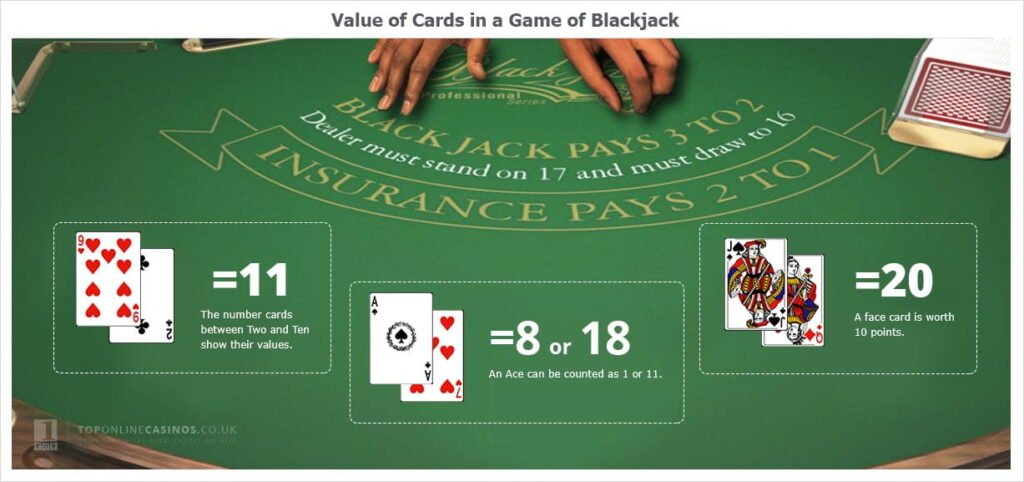
Card Values (This Never Changes)
- Number cards 2–10 = their face value
- Jacks, Queens, Kings = 10 each
- Aces = 1 or 11, whichever helps your hand most
A hand like Ace + 6 can be 7 or 17 – that’s called a soft 17 because the Ace can drop down to 1 if you draw a big card. A hand like 10 + 7 is a hard 17 – fixed total, no flexibility.
What Is A Blackjack?
A blackjack is an Ace + any 10‑value card (10, J, Q, K) in your first two cards.
- In most proper games, a blackjack pays 3:2 (so £10 bet → £25 total back: £15 profit + £10 stake).
- Avoid 6:5 blackjack where possible – that pays less on your best hand and quietly adds to the house edge.
How A Hand Plays Out (Step By Step)
- You place your bet in the betting box.
- Everyone at the table is dealt two cards, usually face up.
- The dealer gets one card face up and one card face down (the “hole” card).
- If anyone has blackjack, that’s checked and paid/settled first (depending on house rules).
- Then the dealer goes round each player, one by one, and you decide what to do with your hand.
- When all players are done, the dealer turns over their hole card and plays their hand according to fixed rules.
- You get paid or lose based on how your hand compares to the dealer’s.
There’s no bluffing, no hidden moves. Your edge comes from making fewer mistakes than the average player.
Your Main Options: Hit, Stand, Double, Split, Surrender
Hit
You ask for another card. You can keep hitting until you stand or bust (go over 21).
Stand
You’re happy with your total and don’t want any more cards.
Double Down
You double your original bet, take one more card only, then stand. This is usually available on the first two cards and is strongest when you’ve got a solid drawing hand against a weak dealer card.
Split
If your first two cards have the same value (e.g. 8‑8, 9‑9, A‑A), you can split them into two separate hands, put an extra bet down, and play each hand individually.
Surrender (if allowed)
You give up your hand straight away and lose half your bet instead of playing it out. This is only available in some games and only as your first decision.
How The Dealer Plays (And Why It Matters)
The dealer doesn’t guess. They follow fixed rules:
- They must hit until they reach at least 17
- Most common: stand on all 17s, but some tables make the dealer hit on soft 17 (Ace + 6)
Dealer hitting on soft 17 is slightly worse for you – the dealer has more chances to improve a weak hand. It’s one of the rule details worth checking on the felt or in the game info box.
Basic Table Rules To Check Before You Play
Before you sit down or click “Deal”, check:
- Blackjack payout: 3:2 (good) or 6:5 (worse)
- Number of decks: fewer decks are generally better for the player, all else equal
- Dealer rule: stands or hits on soft 17
- Double rules: can you double on any two cards? Can you double after splitting?
- Surrender: is early/late surrender offered, or none at all?
These details shift the house edge up or down and matter far more long‑term than any “hunch”.
Why You Need A Basic Strategy Chart
Basic strategy tells you the mathematically best way to play each hand by:
- Your total (hard/soft/pair)
- The dealer’s up‑card
- The rules of the game (number of decks, hit/stand on soft 17, etc.)
You don’t have to memorise it all at once. Many casinos and online games are fine with you using a small printed card or a chart on a second screen.
If you want to stop guessing, your next step after this “How To Play” guide is your Basic Blackjack Strategy page.
Putting It All Together
If you’re a brand‑new player, your first session plan is simple:
- Play a game with 3:2 blackjack and decent rules
- Bet small and flat while you’re learning
- Always know your hand total and the dealer’s up‑card
- Use a basic strategy chart instead of guessing
Once you’re comfortable with the flow of the game, move on to the New Player Blackjack Money Plan guide and start tightening up your money side.