
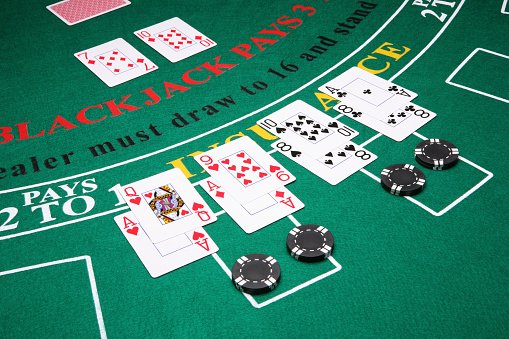
Blackjack is one of the few casino games where your decisions genuinely matter. Play badly and the house edge jumps several percent; use solid rules and basic strategy and you can grind it down under 1% at the right tables. If you’ve only ever “winged it” based on gut feel, this guide will show you how to play blackjack properly: from rules and gameplay through to table selection, basic strategy and bankroll management.
By the end, you’ll know exactly what’s happening in a round, when to hit, stand, double or split, and how to avoid rule traps like 6:5 payouts and insurance that quietly cost you money.
Blackjack in plain English
The goal of blackjack is simple: beat the dealer without going over 21. You’re not playing against other players, just the house.
Card values are:
- 2–10 = face value
- J, Q, K = 10
- Ace = 1 or 11 (whichever is better for your hand)
A typical round goes like this:
- You place your bet.
- Everyone (including the dealer) gets two cards.
- Your cards are usually face up.
- Dealer has one card face up (the upcard) and one face down (the hole card).
- If you have 21 with your first two cards (an Ace plus a 10‑value card), that’s a blackjack.
- If no immediate blackjack decision, each player acts in turn: hit, stand, double, split, sometimes surrender.
- After all players act, the dealer reveals their hole card and plays according to fixed rules (usually hit to 16, stand on 17+).
- You win if your final total is closer to 21 than the dealer’s without busting; you lose if you bust or end up lower when the dealer doesn’t bust. A tie is a push.
The beauty of blackjack is that every decision can be mapped to “best play” based on your hand and the dealer’s upcard. Basic strategy exists precisely for that reason.
Table and rule selection: your first real edge
Before talking about how to play blackjack hand‑by‑hand, it’s crucial to pick the right ruleset. The difference between a good game and a bad one is the difference between a 0.5% edge against you and a 2–3% edge.
Look for tables (live or online) with as many of these as possible:
- Blackjack pays 3:2, not 6:5 – this alone swings about 1.4% of edge.
- Dealer stands on soft 17 (S17), not hits (H17).
- Double down on any two cards allowed.
- Double after split (DAS) allowed.
- Late surrender allowed (you can forfeit half your bet in some bad spots).
- Fewer decks are generally better: single/dual‑deck slightly reduce house edge versus 6–8 deck shoes.
Conversely, try to avoid:
- 6:5 or worse payouts on blackjack.
- Rules that prohibit doubling on many totals.
- No DAS and no surrender on multi‑deck shoes.
Sites like Wizard of Odds and several strategy resources show how each rule tweaks the edge, but as a rule of thumb: if you’re serious about how to play blackjack with a fighting chance, 3:2 payout and S17 are non‑negotiables.
Core decisions: hit, stand, double, split, surrender
At the table, “how to play blackjack” boils down to five actions:
- Hit – take another card.
- Stand – keep your current hand.
- Double down – double your bet, take one (and only one) extra card, then stand.
- Split – if you have a pair, turn it into two separate hands with an extra bet.
- Surrender (if allowed) – forfeit half your bet and give up the hand early.
Some key principles that basic strategy and long‑term experience agree on:
- Always assume the dealer’s hole card is a 10 when you’re thinking through risk – most cards are 10‑value, so it’s a sensible mental shortcut.
- Hit hard totals 8 or below; stand on hard 17 or more.
- Hard 12–16 vs dealer’s 2–6 – you often stand; vs 7+ you frequently hit or consider surrender where allowed.
- Always split Aces and 8s; never split 5s or 10s.
- Double down on 10 or 11 vs lower dealer upcards where the rules allow – these are key profit spots.
Basic strategy charts make these decisions mechanical: you match your hand (hard total, soft total, or pair) with the dealer’s upcard and follow the entry. If you’re playing online, many casinos allow you to keep the chart open; in brick‑and‑mortar venues in some jurisdictions, using a small strategy card at the table is perfectly acceptable.
The biggest leaks seen over the years aren’t “fancy” errors; they’re simple ones: standing on 16 vs 10 when rules/strategy say hit, refusing to split 8s vs 9/10/A, or missing obvious doubles because “it feels risky”.
Basic strategy: turning guesswork into a near‑even game
Unlike roulette or slots, blackjack’s house edge isn’t fixed. It depends heavily on your decisions. Random play might hand the casino a 2–3% edge; basic strategy can cut that to around 0.5% under decent rules.
Basic strategy is:
- A matrix of optimal hit/stand/double/split/surrender decisions.
- Calculated via computer simulations of millions or billions of hands.
- Specific to the rules: decks used, S17 vs H17, DAS, surrender etc.
A couple of examples illustrate how this changes things:
- Hard 16 vs 10 – many players stand because they “don’t want to bust”. Basic strategy often says hit (or surrender if allowed), because long‑term, taking another card loses you less than auto‑standing into a powerful dealer hand.
- Soft 18 (A‑7) vs dealer 9, 10 or A – it feels “strong”, but basic strategy usually says hit or double, because 18 is not good enough against those upcards.
Once you commit to using basic strategy, your role changes from “trying to guess” to “executing a proven plan” and letting variance play out. Emotion doesn’t disappear, but you have something objective to fall back on.
Personal tip: if you’re serious, print a chart for your main ruleset, or save a clear JPEG/PDF on your phone and practice with it at home. The more hands you run through, the more automatic it becomes when real money is on the felt.
Bankroll management and bet sizing
Even with great strategy, blackjack has swings. Knowing how to play blackjack properly includes knowing how much to bet and when to stop.
A simple bankroll framework:
- Define your total bankroll – the money you’re happy to allocate to blackjack over a period (a month or a trip).
- Set session bankrolls – break that into chunks per visit (e.g., £600 total → three £200 sessions).
- Choose a base bet – usually 1–3% of your session bankroll.
- £200 session → £5 base bet fits; £10 is ok if you accept higher variance.
- Set a win goal and loss limit – for example:
- Win goal: +40–50% of session bankroll (e.g., £280–£300 from £200).
- Loss limit: -40–50% (e.g., £100–£120).
Sticking to these rules is the hard part. The moments that wreck players are almost always:
- Raising stakes aggressively after a bad run to “get even”.
- Staying at the table long after hitting a nice profit because it “feels like a hot shoe”.
- Letting a couple of bad beats tilt them into ignoring basic strategy.
Across thousands of observed hands, the players who last longest – and walk with profit most often – are not the luckiest but the ones who treat blackjack like a structured project, not a mood.
Common traps: insurance, side bets and bad rules
A large part of playing well is simply refusing bad deals.
A few things to be wary of:
- Insurance – offered when the dealer shows an Ace; you can bet up to half your original stake on whether they have a 10 in the hole. Mathematically, this is a bad bet in standard play, adding roughly 7% edge on that side bet. Outside of strict card counting contexts, The Online Betting Club view is: never take it.
- Side bets – 21+3, Perfect Pairs, and similar are fun, but they often carry house edges of 3–10% or more depending on the paytable. Treat them as entertainment with tiny stakes if you must, not part of a serious approach.
- 6:5 blackjack – mentioned earlier, but worth repeating: this single rule change quietly wrecks your long‑term results. Avoid tables that don’t pay 3:2.
- Dealer hits soft 17 without compensating positive rules – this adds around 0.2% edge for the house.
If you only sit at good 3:2 S17 tables, use basic strategy, skip insurance and side bets, and manage your bankroll, you’re already playing in the top tier of blackjack players.
Online vs live blackjack: how to practise
Online blackjack (RNG or live dealer) is ideal for learning how to play blackjack without the pressure of a busy pit.
- You can slow down, refer to a basic strategy chart, and play at your own pace.
- Minimum bets are often lower than in brick‑and‑mortar casinos.
- You can track results more easily if you’re disciplined about notes or spreadsheets.
Live casino tables add the social element but can make it harder to stick to your chart if you feel rushed or self‑conscious. That’s why a lot of serious players start online: build the muscle memory on decisions, then take that confidence into a live environment.
Whatever route you choose, treat the first few dozen sessions as training. Keep stakes low, commit to following basic strategy, and pay attention to how different rule sets and your own behaviour affect outcomes.
Conclusion: how to play blackjack the right way
Blackjack rewards players who respect the maths and their own psychology. Learning how to play blackjack properly isn’t about memorising obscure tricks; it’s about:
- Choosing good tables with fair rules.
- Using basic strategy instead of guesswork.
- Managing your bankroll so variance doesn’t knock you out.
- Avoiding traps like insurance, side bets and poor payouts.
When you combine those pieces, you turn blackjack from a wild gamble into a game where you’re only facing a small, manageable edge – about as close to “fair” as a casino game gets.
If you want to go further, the next step is simple: grab a basic strategy chart for your preferred rules, practise on low‑stake games (online or live), and treat each session as a chance to improve execution rather than chase a miracle. Over time, your results and your composure at the table will show the difference.